Showing posts with label science. Show all posts

Thursday, February 12, 2009

1809


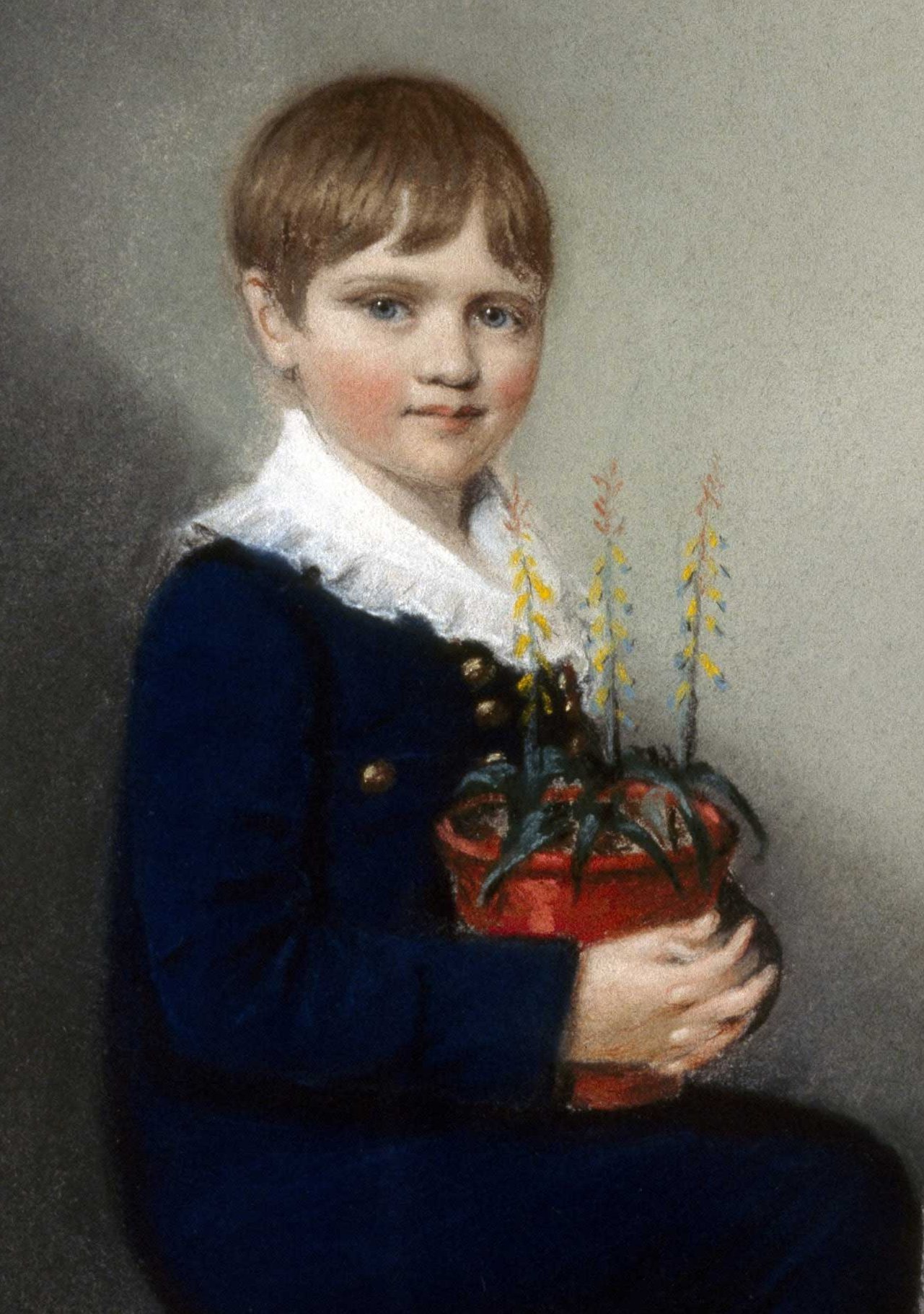
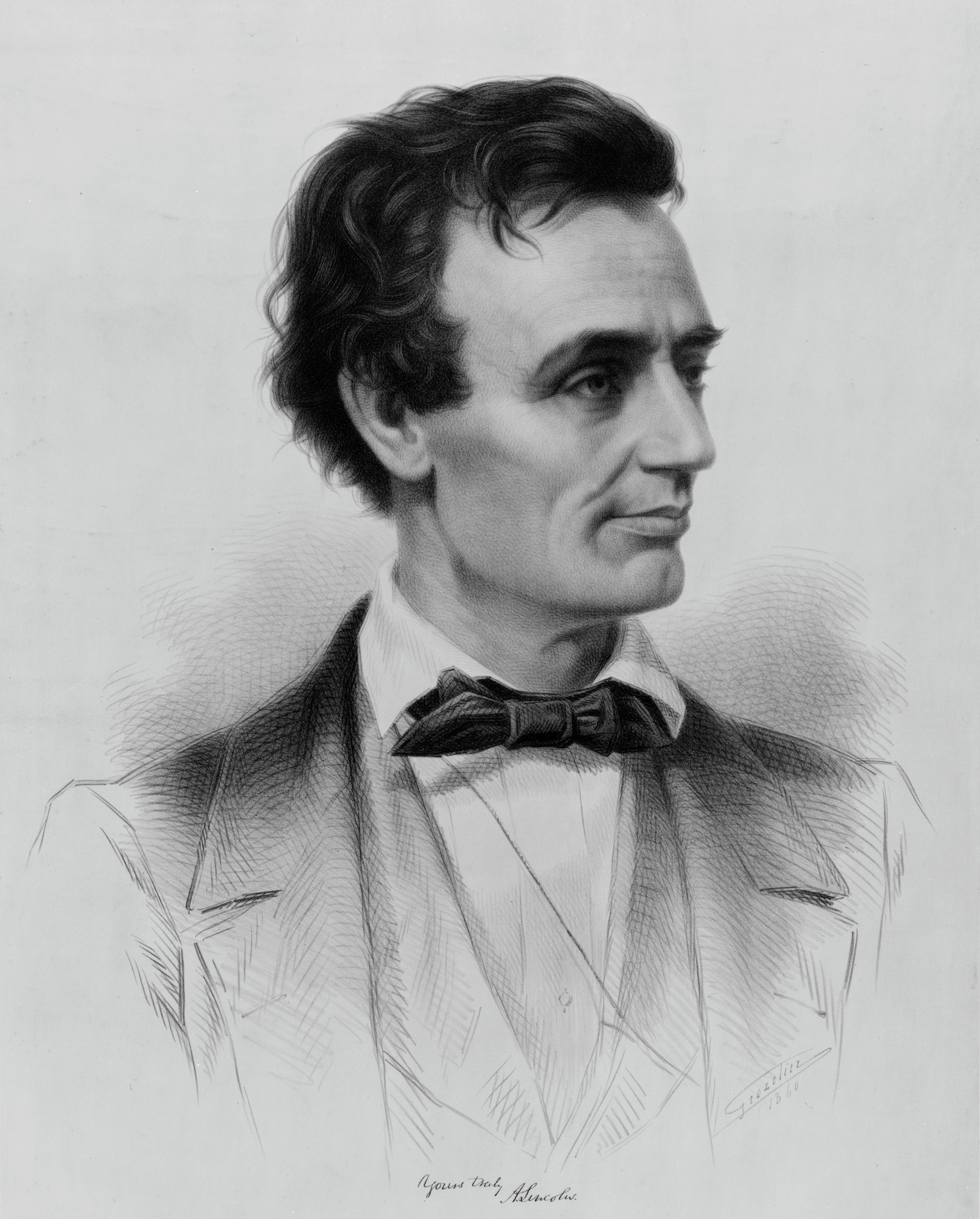
Two hundred years ago today, two of my favorite historical figures were born. Abraham Lincoln was born in a tiny, one room log cabin in Kentucky to two farmers. Charles Darwin was born to wealthy parents (his family owned the Wedgewood China company) in Shrewsbury, Shropshire, England.

Each of these men changed history massively; Lincoln held this country together during one of its most tumultuous times; he promoted equality, inspired troops, and became a symbol for all of us that a person from such humble roots can still succeed at the highest level (for more info on Lincoln, you can read my sister, Katie Hargrave's article here). As stated in Gettysburg on November 19, 1863:


Four score and seven years ago our fathers brought forth on this continent a new nation, conceived in Liberty, and dedicated to the proposition that all men are created equal.

Now we are engaged in a great civil war, testing whether that nation, or any nation, so conceived and so dedicated, can long endure. We are met on a great battle-field of that war. We have come to dedicate a portion of that field, as a final resting place for those who here gave their lives that that nation might live. It is altogether fitting and proper that we should do this.

But, in a larger sense, we can not dedicate—we can not consecrate—we can not hallow—this ground. The brave men, living and dead, who struggled here, have consecrated it, far above our poor power to add or detract. The world will little note, nor long remember what we say here, but it can never forget what they did here. It is for us the living, rather, to be dedicated here to the unfinished work which they who fought here have thus far so nobly advanced. It is rather for us to be here dedicated to the great task remaining before us—that from these honored dead we take increased devotion to that cause for which they gave the last full measure of devotion—that we here highly resolve that these dead shall not have died in vain—that this nation, under God, shall have a new birth of freedom—and that government of the people, by the people, for the people, shall not perish from the earth.


Interestingly, Charles Darwin also believed in equality, and was an avid abolitionist (as a yong man, he learned taxidermy from a freed slave). Darwin's work from Origin of Species, though hotly debated, has held up remarkably well; natural selection is a key biological principle, and provides a beautiful model for how the world has changed to be at its current state. He stated that:

As many more individuals of each species are born than can possibly survive; and as, consequently, there is a frequently recurring struggle for existence, it follows that any being, if it vary however slightly in any manner profitable to itself, under the complex and sometimes varying conditions of life, will have a better chance of surviving, and thus be naturally selected. From the strong principle of inheritance, any selected variety will tend to propagate its new and modified form.
and
There is grandeur in this view of life, with its several powers, having been originally breathed into a few forms or into one; and that, whilst this planet has gone cycling on according to the fixed law of gravity, from so simple a beginning endless forms most beautiful and most wonderful have been, and are being, evolved.

I think this statement is so beautiful; that forms are continually changing in nature, and that we are all a product of our parents and our changing environments. The NY Times has some great info on evolution and natural selection here.

What a lucky day 2/12/1809 was for nerds like me in 2009!

Friday, February 6, 2009

Developmental Neurobiology: A primer.

Note: I am not a developmental neurobiologist!!! I am a behavioral neuroscientist, which is strikingly different, despite the similarly fancy sounding names.  That said, I do understand some basics of developmental neurobiology, which allowed me to understand Dr. McConnell's lecture today.  While I won't go into the details of her talk, I would like to explain the super basics of neurobiology so that you can know, and I can remember.

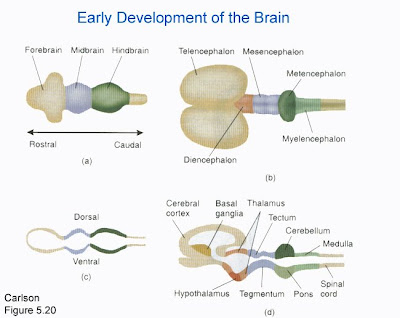
So, when we are developing in utero, we are just a bundle of cells.  These cells start out basically the same, but eventually divide and become different types of cells (neurons, skin cells, bone cells, etc.).  Interestingly enough, these initial cells are most similar to neurons from the get-go.  At some point during development, these cells divide into neurons, and bone/skin cells.  After this happens, the neurons undergo a similar differentiation process, eventually becoming the multitude of neurons that exist in the br
ain.  Meanwhile, the bundle of nerve cells that is developing  (called the neural tube) grows and folds until it is s
haped like the brain we know and love :-)


But how does this happen?  How do these cells know what to become, and where to go?

The answer is fairly simple (although there are complex things going on that I won't go into, partially because I don't know myself!): concentration gradients.

So I said the initial tissue was most similar to nerve tissue.  There are two initial factors on each side of the tube; one side has a factor called Bone Morphogenic Protein (BMP), and the other has a protein called Wnt (the name doesn't really have much meaning to a non-biologist!).  Each one is more highly concentrated on one side, but in the middle there is a mixture.  At each cell, there is a fight going on between these two proteins.  If they are more "Wnt" then they stay nerve tissue.  If they are more "B
MP" they differentiate and become bones and skin, etc.  This gradient continues to act; the nerve cells that are closer to BMP become the peripheral nervous system; the Wnt-iest cells become the brain and spinal cord.

Other concentration gradients form (most notably Sonic Hedgehog) and do basically the same thing; telling neurons what they will become.  

After all of the fighting, there is a time-dependent battle in neurogenesis.  Since some cells want to send their axons to the brain stem, and others want to communicate with the cerebral cortex, more nerve differentiation must occur (if you think of how many neurons there are in the body, this will make sense to you!). 

 Anyway, you start out with a cell called a "progenitor cell."  This cell is like a blank slate for neurons; it can become anything.  Early on, all of these
 cells either lay dormant, or become sub-cortical cells (axons go to brain stem).  As time goes on, these cells become other parts of the brain, but the last ones to develop are the cortex cells (cortical-cortical, meaning they transfer information from one part of the cortex to another).  All of these cells come from the same progenitor cells.
What is interesting is if you take a cell from the beginning process (when it should be turning into a sub-cortical cell) and implant it into the late process (cortical-cortical), the cell will become a cortical-cortical cell.  So the progenitor cell adapts to the environment that is telling it to become cortical-cortical, despite initially wanting to become sub-cortical.

If you take a cell from the end process (when it should be turning into a cortical-cortical cell) and put it in the beginning process, it will lay dormant until the cortical-cortical environment occurs, and it will become a cortical-cortical process.  So basically a progenitor cell loses its ability to adapt to different environments as time goes on.  Eventually progenitor cells become support cells for the brain (glia), or adult stem cells (which can still differentiate into several different types of brain tissue in a similar manner).  

Anyway, if this didn't put you to sleep, you might consider a job as a neuroscientist! :)

Thursday, February 5, 2009

Busy, Busy, Busy...


Today was a long day in a string of long days, and I'm tired, and possibly vitamin-deficient (I took some just recently; I'm hoping it will make me feel better!).  

My day progressed as follows:   Woke up, got coffee from  Greyhouse, and went into the lab a little later than intended, after going to bed super late last night (reading about the "trace" in "trace conditioning."  Super.), then inflated the gastric balloons in my rats, then weighed rat chow, then helped remove food/water from Annette's drunken rats, then ate lunch ((BREATHE!))...

...then began removing alcohol bottles from Annette's drunken rats, this was interrupted when I was bitten by a rat (through the cage!).  After that, I helped obtain blood from RJ's rats via tail nick, then did a surgery, then tried to do another surgery but the rat failed to cooperate [he was anesthesia-resistant!!!], then gathered more blood from RJ's rats, labeled eppendorf tubes, did two more surgeries, read two papers, and went home.  I still have several other papers to read, but I really don't wanna!!!!

I also have three more jugular catheters to put in, I need to write a statement of career goals so that I can continue to have funding, and make intra-gastric balloons for my rats.  Then I will have still more papers to read for Kim/TD's classes, and the sacrifice of this group of LOON rats, as well as another set of papers to read.... I am the worst reader of all time.

I keep trying to get ahead in school and work, but as soon as I'm caught up on one thing, something else creeps up.  It is frustrating!