So, when we are developing in utero, we are just a bundle of cells. These cells start out basically the same, but eventually divide and become different types of cells (neurons, skin cells, bone cells, etc.). Interestingly enough, these initial cells are most similar to neurons from the get-go. At some point during development, these cells divide into neurons, and bone/skin cells. After this happens, the neurons undergo a similar differentiation process, eventually becoming the multitude of neurons that exist in the br
ain. Meanwhile, the bundle of nerve cells that is developing (called the neural tube) grows and folds until it is s
haped like the brain we know and love :-)
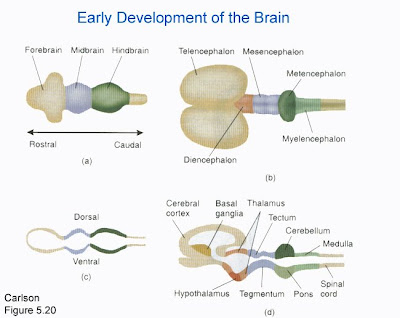
But how does this happen? How do these cells know what to become, and where to go?
The answer is fairly simple (although there are complex things going on that I won't go into, partially because I don't know myself!): concentration gradients.
So I said the initial tissue was most similar to nerve tissue. There are two initial factors on each side of the tube; one side has a factor called Bone Morphogenic Protein (BMP), and the other has a protein called Wnt (the name doesn't really have much meaning to a non-biologist!). Each one is more highly concentrated on one side, but in the middle there is a mixture. At each cell, there is a fight going on between these two proteins. If they are more "Wnt" then they stay nerve tissue. If they are more "B
MP" they differentiate and become bones and skin, etc. This gradient continues to act; the nerve cells that are closer to BMP become the peripheral nervous system; the Wnt-iest cells become the brain and spinal cord.
Other concentration gradients form (most notably Sonic Hedgehog) and do basically the same thing; telling neurons what they will become.

After all of the fighting, there is a time-dependent battle in neurogenesis. Since some cells want to send their axons to the brain stem, and others want to communicate with the cerebral cortex, more nerve differentiation must occur (if you think of how many neurons there are in the body, this will make sense to you!).
Anyway, you start out with a cell called a "progenitor cell." This cell is like a blank slate for neurons; it can become anything. Early on, all of these
cells either lay dormant, or become sub-cortical cells (axons go to brain stem). As time goes on, these cells become other parts of the brain, but the last ones to develop are the cortex cells (cortical-cortical, meaning they transfer information from one part of the cortex to another). All of these cells come from the same progenitor cells.

What is interesting is if you take a cell from the beginning process (when it should be turning into a sub-cortical cell) and implant it into the late process (cortical-cortical), the cell will become a cortical-cortical cell. So the progenitor cell adapts to the environment that is telling it to become cortical-cortical, despite initially wanting to become sub-cortical.
If you take a cell from the end process (when it should be turning into a cortical-cortical cell) and put it in the beginning process, it will lay dormant until the cortical-cortical environment occurs, and it will become a cortical-cortical process. So basically a progenitor cell loses its ability to adapt to different environments as time goes on. Eventually progenitor cells become support cells for the brain (glia), or adult stem cells (which can still differentiate into several different types of brain tissue in a similar manner).
Anyway, if this didn't put you to sleep, you might consider a job as a neuroscientist! :)


 Posts
Posts


